Wednesday, May 30, 2012

PRIVATE LIFE by Jane Smiley ✰✰✰✰✰


This is one of those wonderful, gentle, flowing novels that sweeps you along through the lives of its characters.  I didn’t give it five stars for stunning prose or great characterization (the usual reasons a novel gets five stars from me), but rather for the many inter-twined themes and the ways in which they spoke to me.
Do not mistake me, characters are very important to this novel, and there are a two pivotal ones, surrounded by a rather large supporting cast.  Primarily, the novel is the story of Margaret Mayfield, at twenty-seven a woman on the verge of spinsterhood in late nineteenth century middle America.  Margaret catches the eye of local eccentric academic, Andrew Jackson Jefferson Early, marries him, and moves with him to his Naval posting in California.
As the nineteenth century becomes the twentieth, we see the novel’s themes evolve along with the marriage (the novel’s central theme).  Married to a man who views himself as an important physicist and astronomer and coming from a small town that reveres him as such, Margaret comes to realize certain things over the years as secrets are revealed-but are things really as they seem?  This is a brilliant skirt of the line women at this time in history had to walk within a marriage, a line of loyalty, saccharine smiles, knitting circles, and self-denial.  Other characters bring the other major themes of feminism (one progressive minded individual in particular) and racism (Japanese/American relations) into the novel and into the marriage of Margaret and Andrew.  It was the way in which these latter two themes were threaded through the fabric of the Early’s relationship which I found so masterful, and these elements which took this novel out of the level of another hum-drum look at a pre-feminist movement marriage, which, let’s face it, are rather boring and frankly quite irritating at times for we modern girls to read about.  Yet, at the same time Jane Smiley managed to keep the marriage realistic for the time frame in which she was writing, because she doesn’t make Margaret the feminist-a very good move I thought.
This is, as stated, a gentle, flowing novel about a marriage, but that said, there are many historical events popping up throughout the book.  For instance, the 1906 San Francisco earthquake, the First World War, the Second World War, and in particular the internment of Japanese Americans at Tanforan Racetrack in nearby San Bruno.  Ms. Smiley does an excellent job, aided in part by Andrew’s Naval job and in part by a friendship between Margaret and a Japanese family, due to Margaret’s interest in Japanese art, of inserting a lot of historical flavor and facts into the novel without it feeling overdone.
This is another book that I listened to on audio, and I would definitely recommend Kate Reading’s lovely narration.  Her smooth inflection was just perfect for the tone of the novel.
If you are looking for a character based novel focusing on a turn of the century marriage and interwoven with some relevant themes and events from that time in history this is an excellent choice that I highly recommend.

NANJING REQUIEM by Ha Jin ✰✰✰


This was a book I really wanted to give five stars, for the fact of choosing to write about such grueling subject matter, but unfortunately, I just couldn’t do it.
Ha Jin attempts, in novelized form, to depict the Japanese storming of the Chinese city of Nanjing in December of 1937, a period of weeks which became known as the “Rape of Nanjing” or the “Nanjing Massacre”, due to the awful savagery with which the locals, both civilians and surrendered military alike, were treated by the victorious Japanese army, who raped, pillaged, burned homes, and murdered with shocking brutality somewhere between 200,000 and 300,000 Chinese men, women, and children (we will never know the exact number).
I had two main issues with this novel.  First, I felt that in telling the book from the viewpoint of the rescue workers, the westerners and Chinese who worked in the safe zone and helped to set up and maintain the refugee camps, the reader never really connects with the victims themselves.  It seemed to me as if the action was happening off on the periphery of the story, and I felt a kind of emotional detachment from it.  This was in turn exacerbated by my second issue with the novel: that the prose was very flat and lacking in pathos.  It felt as if I were reading a very dry newspaper rendering at times; frankly, I have read more emotionally charged writing in nonfiction history accounts.  Ha Jin took what should have been a subject bleeding with despondency and drained it of all its human energy.  More focus needed to be on the victims and less on the details of the school; as written, the book lost its impact.
I did appreciate the epilogue at the book’s end, letting the reader know what became of Minnie Vautrin at the end of her life, and what became of the college, but it really was beside the point of the novel.
In fairness, I must say that I listened to the audio of this book, and I did not like the narrator.  Her style was very stilted.  Initially, I wondered if this might have something to do with my feelings regarding the book.  However, after writing the bulk of my review I read some other reviews and discovered that others also feel the same way that I do, so I do not think that it is just the stilted narration which affected my viewpoint.  Overall, a take-it or leave-it book for me.

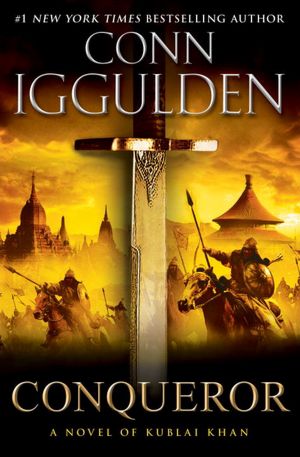
CONQUEROR by Conn Iggulden ✰✰✰✰


The latest in Conn Iggulden’s series on Genghis Khan and his descendants, this novel focuses primarily on Kublai Khan, and his transformation from gentle scholar to Mongol warrior.
This book contains all the elements of the others: great medieval battle scenes, intrigue as family members vie for the khanate, and glimpses into the Mongol culture-including its strong women.  Kublai comes through as clearly one of history’s greatest khans, and both his private and public sides are ably etched.  Although you do not absolutely need to read all the books in order, I would recommend it, as it will give useful background information which will enhance the reading of the later books.
A fantastic writer, Iggulden’s books are well researched; you settle easily into the ambience of a Mongol camp or city.  The plot is fast paced, but despite shifting lines, there is never any confusion, even in the audio, as to which plot thread you have jumped into.  His characters seem to step right off the pages of history and into their own distinct personalities.
I finally listened to one of these Khan books on audio, and I must say, I did enjoy it.  It was nice to have all the names, after four books, pronounced for me; perhaps I should have thought of that in book one!  The audio was well done, and I would definitely recommend it; these would be excellent books for men and women alike to listen to on road trips, as the themes would easily appeal to mixed audiences.
As with all the others, this one is a solid, four star read for me.  Great entertainment for all readers of medieval historical fiction.  

Thursday, May 10, 2012

NOTES ON A CENTURY by Bernard Lewis ✰✰✰✰


The Short Version

Bernard Lewis is a renowned Middle Eastern historian approaching his century mark.  In this his swan-song he gives a brief biographical sketch from his early years through the time he begins to achieve fame in his field, gives favorite anecdotes from a lifetime spent as confidant and advisor to rulers and statesmen and from his career in academia, and finally, answers some of his critics.  While very different from his multitude of scholarly writings, this one is still packed with tidbits of analysis and history and well worth reading for both those familiar with Professor Lewis’ earlier writings and those who are meeting this great mind for the first time.

The Long Version

This was perhaps one of my most anticipated pre-publication review manuscripts, and while it was very different from what I expected, it did not disappoint.  A Middle Eastern scholar of great renown approaching his hundredth year, Professor Lewis is certainly no stranger to publication-he has thirty-two books, which have in their turn been translated into twenty-nine languages, to his credit.  In the past decade and a half he has churned out a stunning dozen books which he himself gives explanation of in this book as a cleaning out of his files, the desire to finish, before he departs this earth, all the loose ends of research that he has left hanging about his cabinets.  This book is very different.  It truly is notes on a century.
The first section of the book reads almost like a biography, in which Professor Lewis gives an account of his youth, university years, initial jobs in academia, war service during the Second World War, and finally his return to teaching after the war.  In this organized biographical sketch a clear grounding of the prominent man in his field that Professor Lewis would become is laid.  We see the boy with a phenomenal facility for languages who would later become the man proficient in fifteen.  We are introduced to the young British intelligence officer who would in time become confidant and counselor to monarchs and statesmen.
In its middle portion the book gains the feel of its title, being composed of a series of vignettes spanning the many decades of Professor Lewis’ professional life.  Here he shows himself to be a man of charm and first-rate storytelling ability, in addition to the political and historical insight for which he is renowned.  The various tales range from academia and research, to world leaders he met either in a consulting or social capacity.  At times he give very brief historical sketches, in order to give his readers background information that they might need to understand, and thus more thoroughly enjoy, his stories.  Ever the teacher, despite being a very brilliant man, Professor Lewis is very readable by an average person, because he remembers that events which he might hold as common knowledge, his reader probably does not.  Because of this, this book is a wonderful refresher, or introduction, to such things as the wars between Israel and Egypt in the Sinai and the various conflicts between Israelis and Palestinians.
The final section of the book is used to answer some of the controversies which have surrounded him, as is inevitable given his academic stature.  Perhaps the largest of these, but the one which surprisingly he gives the least amount of ink, was the large scale battle of many decades launched by the Palestinian born, Columbia University English professor Edward Said, in his famous book, Orientalism.  The main thrust of Said’s attack against western born scholars of the Middle East is that their slant on the history and politics of the region encouraged imperialism to flourish.  While the argument is of course deep, scholarly, and far too complex to get into here, or even in Professor Lewis’ most recent book, he does use this book to reiterate once again his feelings that Professor Said has missed a couple of main points, among them the fact that there were chairs of Oriental studies in European universities centuries before there were any moves towards colonizing any of those countries.  He also puts forth the point that while native born historians do provide invaluable cultural insights into their peoples, often truly objective history can only be written by outsiders.
In addition to a number of lesser issues, one other major issue is addressed: the controversy which arose from Professor Lewis’ refusal to grant Armenian victim’s the title of “holocaust”.  He came under extreme censure, including legal, for this decision, but stands by, and defends his research as an historian, believing that the facts simply do not support the definition of holocaust as defined by the experience of the Jews in World War II, which is the commonly accepted definition among scholars.
In summation, this book is vastly different from the scholarly works that students of Professor Lewis are accustomed to reading, but very much worth the time, especially for those who have never read any of his books, or for those who do not have a very strong working knowledge of his subject, as he does not assume that his reader is beginning with any.  Professor Lewis’ easy charm comes through with little pretension, and even when the subject matter does become a bit academic the writing style is so perfectly clear, and the author so absolutely in command of his subject, that the reader is easily carried along.  Long-time readers of Professor Lewis will enjoy the amusing anecdotes of this his swan-song, even if there is probably very little new here for them from a scholastic standpoint.  

Sunday, April 22, 2012

THE SEWING CIRCLES OF HERAT by Christina Lamb ✰✰✰✰


As a young woman, Christina Lamb traveled to Afghanistan, and through a mix of persistence, courage, connections, and writing talent managed to document the final two years of the struggle for Afghan freedom against the Soviets.  Over the years she kept her finger on the pulse of the region, wrote a couple of books, and ultimately returned again at be on the ground as the Taliban breathed its last in the early months of 2002.
Christina Lamb is a wonderful writer with a knack for interweaving just the right amount of her own personal narrative in with the current events about which she is writing.  In addition, she casts back into the past and gives a whole lot of background information on Afghan history, politics, monarchy, trade, and agriculture.  I especially loved sections of the book where she discussed the architecture of the city of Herat during the height of its beauty, juxtaposing it against its current state.  While Herat may be in the title of the book, many cities are given equal coverage, among them the more conservative stronghold of Kandahar and the capital city of Kabul.  The book is fairly accurately titled in that women’s issues are very prominently featured in the narrative, and she discusses the history of different areas of Afghanistan with regards to women, education, and the arts, both before and after the Taliban.
Lamb does an excellent job bringing the reader’s senses to life and into her environment; readers feel the ruts beneath the airplane wheels and the grit of the dust storms-you smell the pine trees and taste the mutton.  Hearts ache for the children who lack for the most basic things-she heads one of her chapters with a quote that I love from the Persian poet Rumi: “Look at your eyes.  They are small but they see enormous things.”  The things that these children have seen and survived defy comprehension.  Indeed, the 2012 Pulitzer Prize for Breaking News Photography was awarded to Massoud Hossaini for his horrific shot of a twelve year old girl screaming in fear amidst a mass of bodies moments after a suicide bomb detonated in Kabul. (I have linked it here-I warn you, it is graphic.)  That same sense of place and culture comes through in the tenor of Christina Lamb’s writing; she spent a lot of time among the people, not sitting in the hotel with her western journalist coworkers, and it shows.
My one complaint, and the single factor that kept me from giving the book a fifth star, is that at times her timeline can get rather discombobulated as she tries to focus on specific people or places.  I would have preferred that she take a more chronological approach; obviously those places where she goes back to the Mongols that is not possible, but a stricter chronology from the late 1970’s to the 2000s would have made for a much tighter narrative.  My preference would have been to provide a listing of people at the beginning of the book, to help readers who have difficulty keeping all of the similar sounding Middle Eastern names straight, and then travel chronologically through the story, letting readers refer back to the list to refresh their memories as players come up again.
There are a lot of books out there on this topic.  This is a very good one for people without a lot of background, as the author does an excellent job giving the reader everything needed.  It was published in 2002, so many of the players have since been apprehended, but that doesn’t in any way take away from the history of it.  Overall, I highly recommend this energetically written, informative account.

Sunday, April 15, 2012

ATLAS SHRUGGED by Ayn Rand ✰✰✰ and 1/2


This is a tough book to review from a “star” standpoint.  If someone were to ask me would they like this book as a reader, from a pure plot, character development, etc. standpoint, the answer would be an “um...errr... I would really need to know a lot more about you”.  On the other hand, if someone wants to read a book purely for its merits as a study of economic and social systems, there might be too much character development in this one for their liking.  In short, I have been pondering what to say in this review since about half way through this thousand plus page tome.
Through her novels, screenplays, plays, and works of nonfiction, Ayn Rand put forth a philosophy which she termed “Objectivism”.  In its simplest form, Objectivism holds that a man lives first and foremost for his own welfare and happiness, and he expects others to do the same.  It rejects the idea of man being a victim to any force beyond his control, be it a government, or a deity-man is in control of his own destiny.  Objectivism states that each individual man is responsible for doing his own thinking and should never surrender his choices and thoughts to any other person or organization-reason should rule each individual’s decision making process, and it should be done individually.  Man has a conscience in order to perceive reality, not to invent one of his own desiring.  What is is; reality can not be changed.
Obviously, any person of faith would have serious issues with Ayn Rand’s philosophy.  I happen to believe very strongly that a world where everyone looks out for themselves first and foremost is a self-centered world, which, at the very least, goes again the formation of even family units, let alone larger societal groupings.  So, there were many parts of the book which I found very unrealistic because I simply didn’t buy into Rand’s rhetoric.  Those who are familiar with my reviews know that I am not fond of economics and existential philosophy.  The economics was actually fairly gently woven into the plot of the novel, and I went along willingly for the ride.  Rand’s philosophy gets shoved down the reader’s throat.  In one case in a one hundred fifty page speech, two hundred pages from the end of the book-talk about bringing the plot to a screeching halt!  Social philosophy is also near and dear to Ms. Rand’s heart, but at least social topics are easier for me to wrap my brain around than existential ones.  I can much more readily grasp Marxism than rationalism, and so the many pages that were devoted to those aspects of the plot (or simply expounded upon by the characters in conversation), I actually enjoyed and felt that she did a good job working into her story.
Ayn Rand used all of these various theories and philosophies to create an America in which the government is taking over the country, nationalizing, for the good of all, all of the major industries-controlling hiring, movement of goods, and eventually even intellectual rights.  For instance, if you invent something worthwhile, everyone needs to be able to manufacture it, not just your company.  There are two opposing groups of main characters, the governmental types and the industrialists who are fighting back, but who seem to be disappearing.  Through her book she creates an incredibly complex and believable picture of what could happen.  The plot structure was compelling, had good forward momentum, and despite the book’s length, kept me engaged.  I thoroughly enjoyed this aspect of Ayn Rand the writer; the one area where I felt let down as a reader of a novel was with regards to the great love triangle she had built up all through the book-I hated the way she resolved it!  She resolved it based on her philosophical self, not as a novelist, and as a reader of a novel I was very dissatisfied.
Obviously, this is not a book for those looking to read a simple novel.  You have to be willing to stomach a fair amount of both social and existential philosophy, politics,   economics, and a fairly complex plot structure that is business related.  For me it was a three and a half star novel, rounded up to four when forced to, given my respect for Ayn Rand as an intellectual; for someone with more interest in philosophy it would absolutely be a four, perhaps even a five, star novel. 

RANSOM by David Malouf ✰✰✰✰


Books that take one scene or element from a well-known work of literature and expand upon it, giving further background or depth fascinate me, especially if they are well done; I tend to never view the primary work in quite the same light ever again, and I feel enriched, despite the fact that the two authors often lived centuries apart, and the primary one might heartily disapprove of everything the second one wrote.  Somehow, I think Homer would love David Malouf’s rendering of King Priam and Achilles.
****IF YOU HAVE NOT READ THE ILIAD THERE WILL BE SPOILERS HERE****
Malouf chose as his moment in literature the section of Homer’s Iliad in which Achilles is refusing to fight, for reasons too complicated to get into here, and his best friend Patroclus convinces him to loan him his armor, saying that it will at least rally the Greeks if they see his armor on the field and believe that it is Achilles come to do battle.  Of course, Hector believes that the two heroes finally get the chance to face each other on the field of combat, and, not realizing that it is Patroclus, not Achilles, in the armor, he kills him.  Achilles, in a fury of grief, calls out Hector, slays him, and then proceeds to defy all convention by treating his corpse in a most appalling fashion.  All of this is well documented in Homer’s Iliad.
Where Malouf begins to build his novel is around the backstory of the childhood friendship of Achilles and Patroclus, how they came to be raised as brothers.  He also tells in riveting detail the tale of how King Laomedon’s son, Podarces, found refuge during the sacking of their city among the slaves and servants.  When Podarces’ sister, Hesione, was taken captive by the conquering Heracles he promised her any gift she desired; knowing her brother was hidden among the slaves, she led Heracles there and pointed to Podarces and said that he was her brother and she wanted him.  Disbelieving that the filthy urchin was really the prince, and thinking Hesione deluded in her grief, Heracles christened Podarces “Priam”, meaning “the ransomed one”, or “the price paid”-his worthless life in exchange for her brother’s.  And so was “reborn” the boy who became the king of Troy.
Ransom begins as a story of vengeance-that of Achilles grieving his friend and brother Patroclus-a familiar story to those who have read Homer’s Iliad.  No matter how he tries Achilles is unable to assuage his anger.  The story then shifts to Priam and Hecuba, the parents of Hector, as they grieve their son.  Priam’s visit to Achilles, unadorned, as a common man, bearing a cart of treasure for ransom, but coming as a broken father, not a king, does figure into Homer’s work.  However, David Malouf has chosen this element of the tale to really expand upon and carry the emotional weight of his novel.  In his work we see Priam’s entreaties to his wife and family; we learn, through flashbacks, about his childhood; we see his preparations; and his journey with the course carter who becomes, in an odd way, his friend.  Through Malouf’s lyrical, simple prose we see an old, dignified man grieve, accept change, and face his own imminent death.
****END OF SPOILERS****
You do not have to have read Homer’s Iliad to read Ransom.  Any background information is given, and parts of the novel are simply taken from the author’s own imagination.  This is a wonderful novel, even for those who are not inclined to read ancient epic poetry.  The story of Achilles and Priam is a fairly well known one, discussed even outside the context of The Iliad.  Indeed, Malouf’s intent was a study of grief, in its many forms.  Just about every form of grief is touched upon through one character or another in the course of this novel, but that said, it manages to not be a depressing read.  Malouf’s writing is graceful and emotive and I look forward to exploring more of his work.